Timber frame construction is one of the oldest structural systems in European building history. It relies on a skeleton of large-section timber members — posts, beams, and braces — to carry loads from the roof down to the foundation, leaving the wall planes free of structural function. This fundamental characteristic distinguishes timber framing from other wood construction methods and gives it its particular architectural quality: spans can be long, openings wide, and internal layouts flexible.
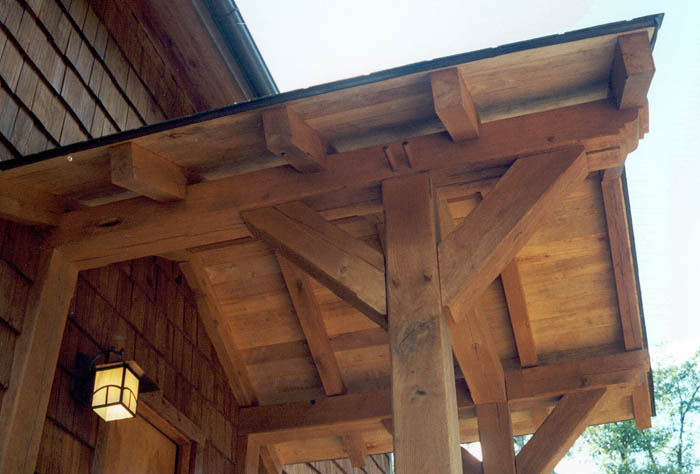
The Structural Logic of Post-and-Beam Framing
In a post-and-beam system, vertical posts carry compressive loads. Horizontal beams spanning between posts carry bending loads from floors and roofs above. Diagonal braces resist lateral forces — wind and seismic loads — that would otherwise cause the rectangular frame to rack. Together, these three element types form a complete structural system.
The key design challenge in timber framing is managing the connections. Timber is strong in compression along the grain but weaker in tension perpendicular to the grain. Well-designed connections transfer forces efficiently without introducing tension perpendicular to the grain, which can cause splitting.
Traditional Joinery: Mortise and Tenon
Before mechanical fasteners, timber framers relied on carved wood joints. The most common is the mortise-and-tenon: a projecting tenon cut from the end of one member fits into a corresponding mortise cavity in the receiving member. A wooden peg — a treenail or Holznagel — is driven through aligned holes in both pieces to lock the joint against withdrawal.
The geometry of these joints matters structurally. Shoulders cut around the tenon bear compressive loads directly from face to face. The tenon itself resists shear and, under some loading conditions, tension. Traditional framers developed numerous variations — the housed mortise and tenon, the wedged tenon, the dovetail — each suited to different load configurations and connection angles.
In central Europe, including Germany, the craft of timber joinery was organised through the Zimmerei (carpentry) guilds. The Fachwerk (half-timbered) tradition that characterises towns such as Quedlinburg, Goslar, and Celle in Lower Saxony represents centuries of accumulated knowledge about how wood performs as a structural material under varying humidity, temperature, and loading conditions.
Fachwerk vs. Holzrahmenbau
Historic Fachwerk uses large-section timbers, typically 120 mm × 120 mm or larger, with infill panels of wattle-and-daub, brick, or later materials between the structural members. Modern Holzrahmenbau (timber frame construction) uses smaller-section studs — often 60 mm × 140 mm or 60 mm × 160 mm — at regular centres (typically 62.5 cm), with sheathing boards providing racking resistance. The two systems share the same basic load path logic but differ in member sizes, connection methods, and the role of the infill material.
Load Paths in a Timber Frame
Understanding load paths is essential when working with any structural timber system. Dead loads — the self-weight of the structure — are present continuously. Imposed loads from occupants and contents vary with use. Wind loads act horizontally. Snow loads in central European climates can be substantial, particularly at roof level in alpine or pre-alpine zones of Germany.
In a correctly designed timber frame, each load traces a direct path from where it is applied down to the foundation bearing. A floor joist transfers its load to the beam below it; the beam transfers to the post; the post transfers to the sole plate or foundation pad. Interrupting this path — by cutting through a post without adequate redesign, for example — compromises the structural integrity of the whole system.
Bracing Against Lateral Forces
A rectangular timber frame without diagonal bracing is geometrically unstable under lateral loads. Three methods are commonly used to provide stability:
- Diagonal timber braces — cut diagonally into the frame between posts and beams, forming triangulated panels. This is the traditional approach in Fachwerk construction.
- Sheathing panels — rigid boards (OSB, plywood, or solid timber boarding) fixed to the face of the frame create a shear wall. This is the standard approach in modern Holzrahmenbau.
- Knee braces — shorter diagonal members at post-to-beam connections, common in post-and-beam systems where full diagonal bracing is not used.
The choice between these methods affects the layout of openings, the insulation strategy, and the fire performance of the assembly.
Timber Species and Grade
In Germany, structural timber is predominantly softwood: spruce (Fichte) and fir (Tanne) are most common, with pine (Kiefer) and larch (Lärche) used where durability against moisture is a consideration. The structural properties of these species vary — larch, for example, is denser and more durable than spruce but also heavier and harder to work.
DIN EN 338 defines strength classes for structural timber. The classes most commonly used in Germany for Holzrahmenbau are C16, C24, and C30. A higher class number indicates higher characteristic bending strength, modulus of elasticity, and density. In practice, most construction-grade timber in Germany is graded C24 by visual or machine assessment.
Moisture content is critical. Green (freshly felled) timber can have moisture content above 50 percent. As it dries to equilibrium with its surroundings — typically 10 to 15 percent in a German climate — it shrinks, and differential shrinkage across the cross-section can cause checking (surface cracking) and distortion. Kiln-dried or technical air-dried timber reduces these effects when used in enclosed structural applications.
Contemporary Timber Frame Systems
Modern timber frame construction in Germany draws on the same structural logic as traditional Fachwerk but integrates it with current requirements for thermal performance, air-tightness, and fire resistance. A typical Holzrahmenbau wall assembly consists of:
- Exterior cladding (timber boards, fibre cement, or render on a ventilated cavity)
- Wind-tight board (e.g. wood fibre board or OSB)
- Structural stud frame with insulation between studs
- Air-tightness membrane (vapour retarder)
- Services cavity and secondary insulation layer
- Interior lining (plasterboard or timber board)
This layered assembly achieves U-values well within the requirements of the Gebäudeenergiegesetz (GEG) while maintaining the structural function of the timber frame. The air-tightness layer is particularly important: inadequately sealed timber frame buildings are prone to interstitial condensation, which can lead to timber decay over time.
Further Reading
- DIN EN 338:2016 — Structural timber: strength classes
- DIN EN 1995-1-1 (Eurocode 5) — Design of timber structures
- Informationsdienst Holz — technical publications on timber construction (in German)